How I’n’I Design helped Adopture show what AI adoption looks like when it is already working — and put the problem in its proper place.
Adopture came to us in a moment of transition.
Formerly AI Business Foundry, the company was rebranding around a clearer understanding of its role: helping organizations move beyond simply giving people access to AI, and toward making it genuinely useful in the way they work.
The new name brought that purpose into sharper focus. But the website still had to give the name meaning. It needed to help people understand what made Adopture different — and feel that someone capable was ready to help them move forward.
I’n’I Design worked with founders Roger Campbell II and Chelsea Jennings to shape the positioning, story, structure, and visual direction of the new site.
Adopture works in a gap most organizations discover after the rollout. A company can purchase the tools, complete the deployment, and announce that AI has arrived. The real work is what happens next: helping people build confidence, reshaping how work actually gets done, and giving leaders evidence that something has changed.
The original experience explained this problem thoroughly. It also asked visitors to spend a long time inside a frustration they already understood. Anyone who had run a stalled rollout did not need it described back to them.
In our conversations, Roger and Chelsea kept returning to something underneath the technology. They wanted Adopture to feel like a capable partner had taken hold of the work — someone steady, practical, and present beyond launch.
The organization is working. The future has direction. Leadership does not have to carry it alone.
The feeling was an exhale. That became the thing to design. I wrote about the session where that became clear in The Exhale.
The earliest visual directions showed complexity becoming simple: disconnected information, scattered data, chaos resolving into order. They were accurate. They were still asking the visitor to look at the failure.
The more useful question turned out to be a different one: what does an organization look like when AI adoption is already working? Not the rollout that stalled. Not the tools sitting unused. The future the client is trying to reach.
That question changed the story.
The homepage now opens inside an organization where people have space to think. Teams are creating, testing, discussing, and deciding. Technology moves quietly through the environment without becoming the spectacle. The people — and what they are now able to do — stay at the center.
The problem did not get removed. It got put in its proper place.
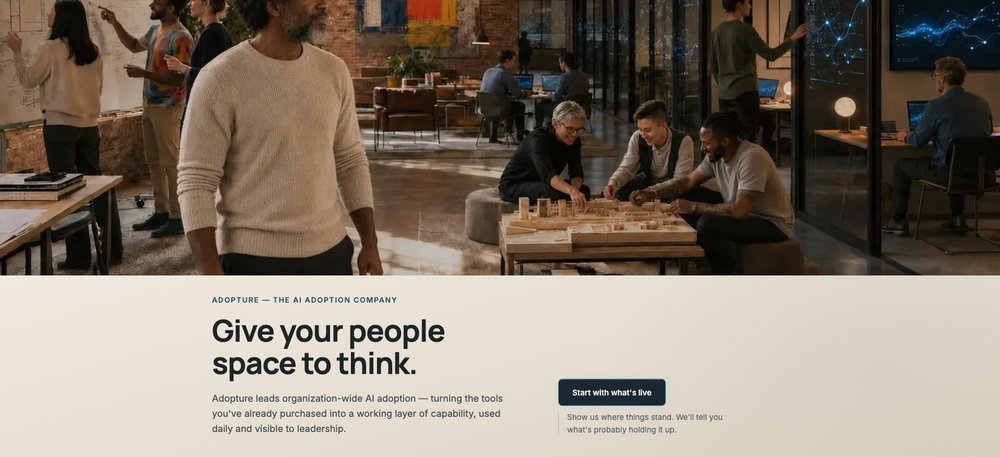
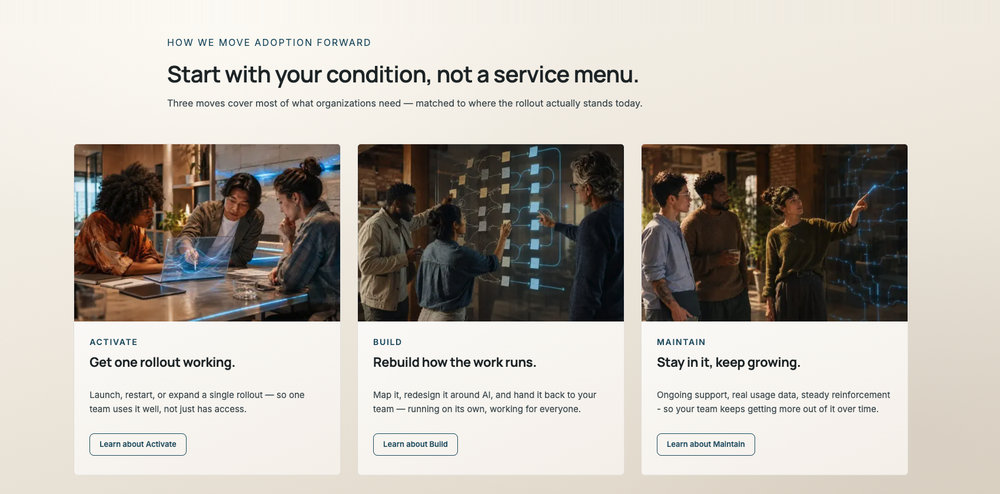
The same principle shaped the rest of the site. Rather than presenting a conventional list of consulting services, Adopture begins with the condition an organization is already in. Does one rollout need to start working? Does a process need rebuilding around what AI can now do? Does early adoption need support to keep growing?
Activate, Build, and Maintain give each condition a clear next move. They are entry points, not stages: an organization can begin wherever the work already is.
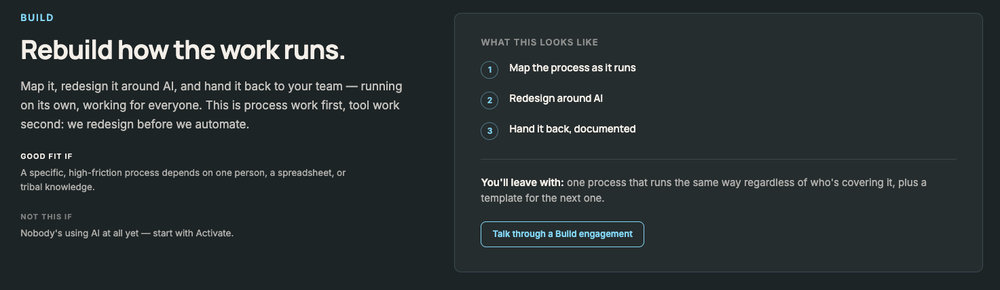
Each move also says plainly when it is — and is not — the right fit, helping visitors recognize where to begin without needing a call first.
The visual language had to carry the same argument. Human complexity stays visible: the notes, conversations, judgments, and accumulated knowledge that already shape how an organization works. Alongside it, a deliberately restrained blue current makes progress legible — scattered information beginning to gather into something clearer and more usable. It appears sparingly. It is signal, not decoration.
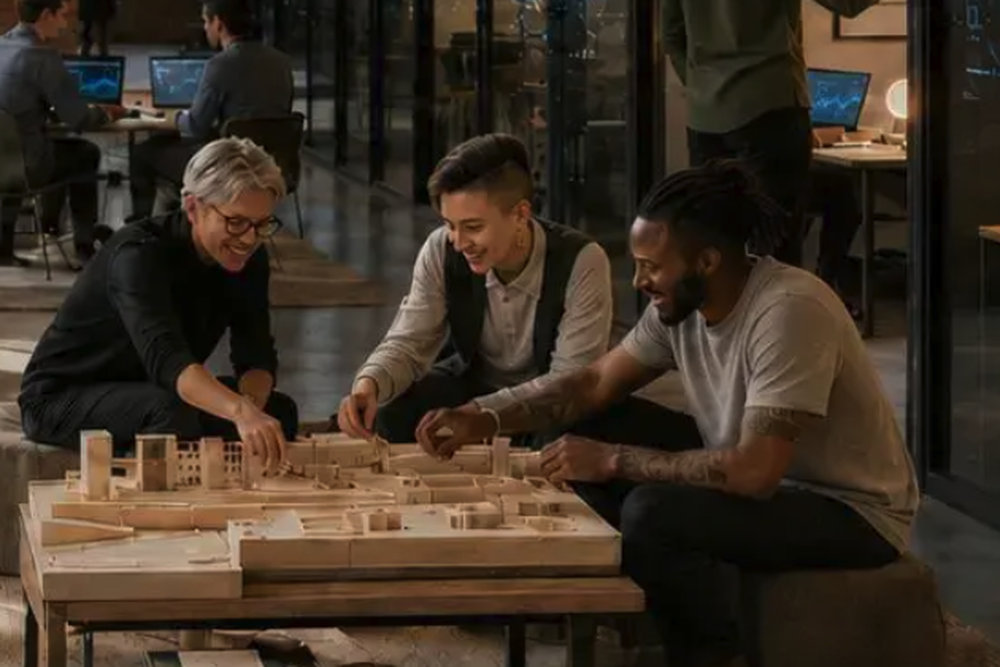
AI is present, but it does not erase the human work that came before it. It helps that work become structured, repeatable, and easier to carry forward.
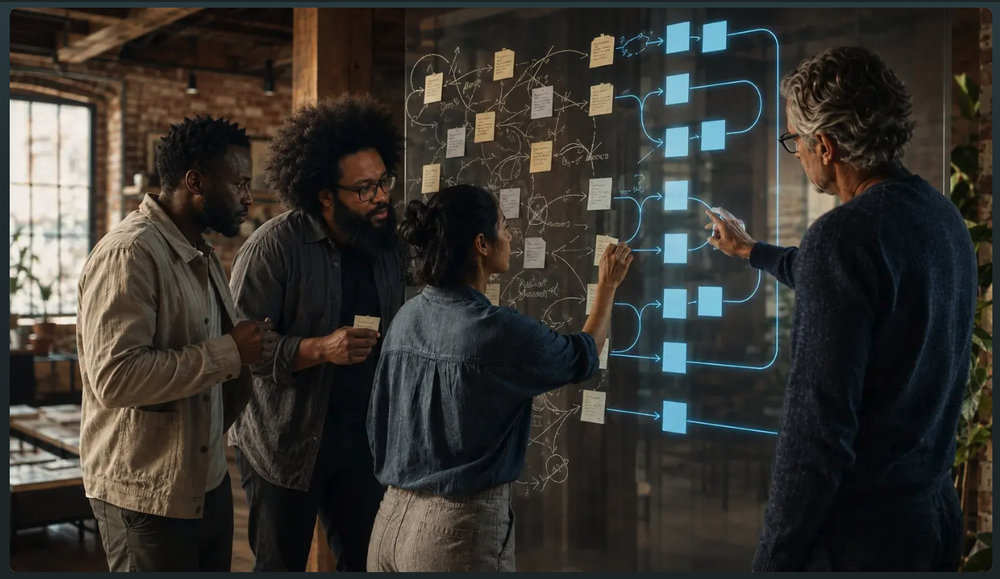
That world extends past the homepage — into the services, the founder story, the work with leadership teams, and the conversations held in the room. Warm industrial spaces keep the company grounded. Glass creates transparency and possibility. Blue appears as movement. Across every page, people remain participants in the change rather than background figures in a story about technology.
The implementation-ready prototype was handed off with a clear path into React and a CMS, allowing Adopture to move into production without rebuilding the thinking underneath it.
The result is a site that no longer asks visitors to work so hard to understand what Adopture offers. It lets them see the promise first — an organization where AI is no longer something people simply have access to, but something they know how to use.
The company was becoming Adopture. The new experience gave that name a world to live in.
 I'n'I
I'n'I